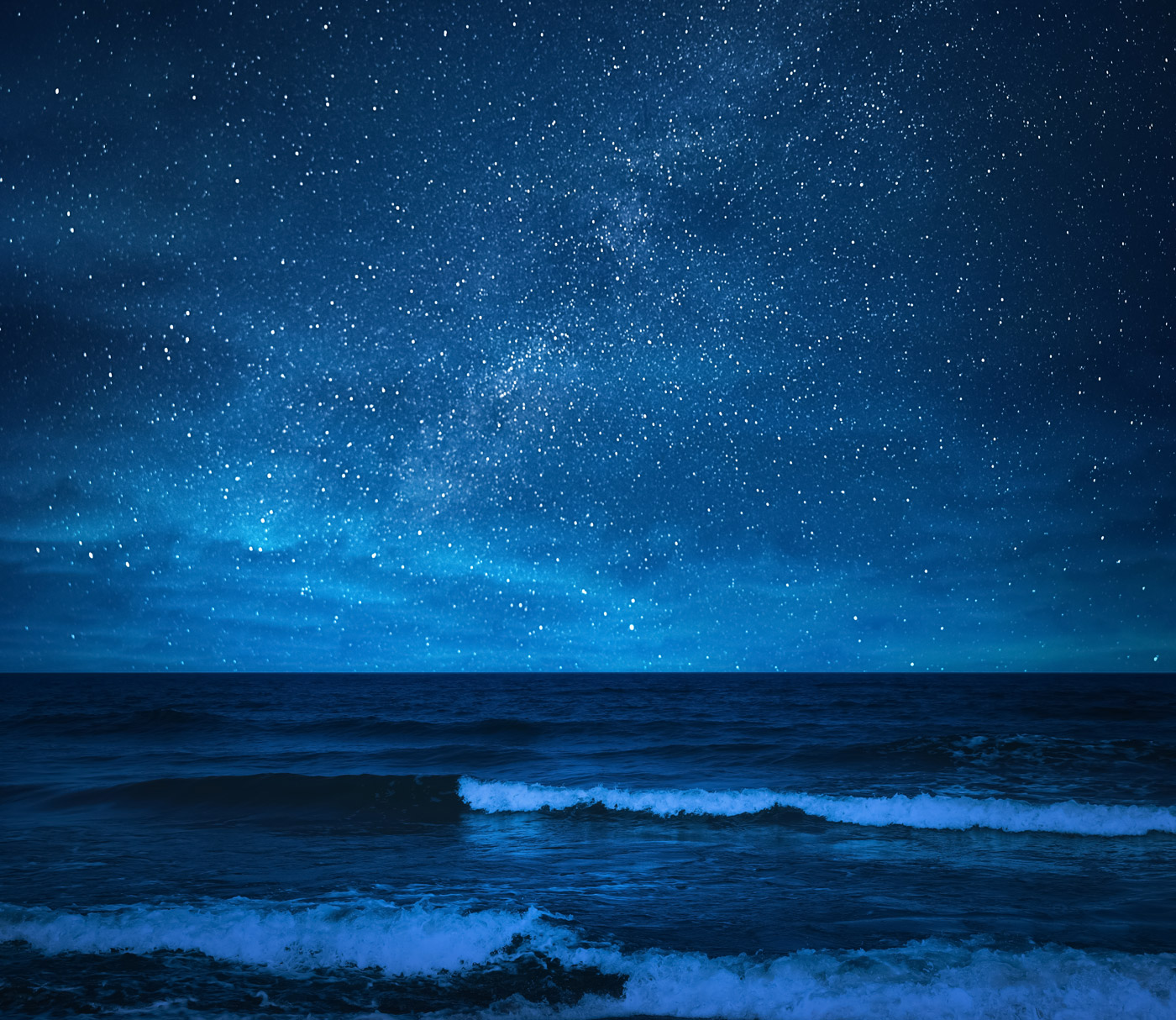
When Abraham obeyed God, God made him a remarkable promise:
“. . . because you have done this and have not withheld your son, your only son, I will surely bless you and make your descendants as numerous as the stars in the sky and as the sand on the seashore.”
God compared the number of Abraham’s descents to the stars in the sky and the sand on the seashore.
So, which one is greater—stars or grains of sand?
To find out, we’d just have to count every grain of sand on Earth, and then count every star in the sky using the most advanced telescopes. Sounds simple . . . but it’s definitely not. Thankfully, scientists have already taken on this challenge. According to their research, an adult can scoop up about 8 million grains of sand with both hands. When scientists factor in the total area of beaches and deserts around the world, they estimate that Earth contains about 10²² grains of sand.
A research team led by Dr. Simon Driver at the Australian National University announced that there are about 7 × 10²² observable stars in the universe, which is roughly seven times more than the number of grains of sand on Earth. It’s an incredible number, but when you think about how vast the universe is, it almost makes sense. What’s clear is this: Whether we’re talking about sands or stars, there are far too many for a human to ever count in a lifetime.
But here’s something even more interesting. Sometimes, something incredibly small and ordinary can hold a number just as overwhelming.
Take water, for example. Water is made of H₂O—two hydrogen atom bonded to one oxygen atom. Based on the mass of these atoms, scientists calculate that just 1 gram of water contains about ⅟₁₈☓6.022☓10²³ molecules. One scientist puts it this way: a single spoonful of water contains about 120 times more molecules than all the stars we can observe in the universe. Think about it—not the vast universe or the endless ocean, but just one spoonful of water, holding more than we could ever count. That’s truly amazing.
Just as there is more in this world that we can’t see than what we can, there is far more we don’t know than what we do know. That’s why this isn’t a world where we can easily jump to conclusions or make quick judgments.
Student life sits right in that awkward in-between space—no longer a child, not yet an adult—filled with busy, complicated days. On public transportation, you pay a youth fare, but at a buffet, you’re charged the adult price. Attention can feel annoying, yet being ignored still hurts. You feel frustrated, wondering why no one understands you, while you don’t fully understand yourself either. Not knowing yourself also means not knowing your limits. And that means there may be possibilities within you that you haven’t discovered yet. Hidden inside all that confusion could be countless unseen potentials—far more than you ever imagined.
So let’s not trap ourselves within what’s visible or define our limits by what appears on the surface. Just because we feel small or insignificant doesn’t mean there’s nothing inside us. Even a single drop of water holds a number of molecules that comes close to infinity. Like shining stars in the sky and the sparkling grains of sand on the shore, countless possibilities live within us.